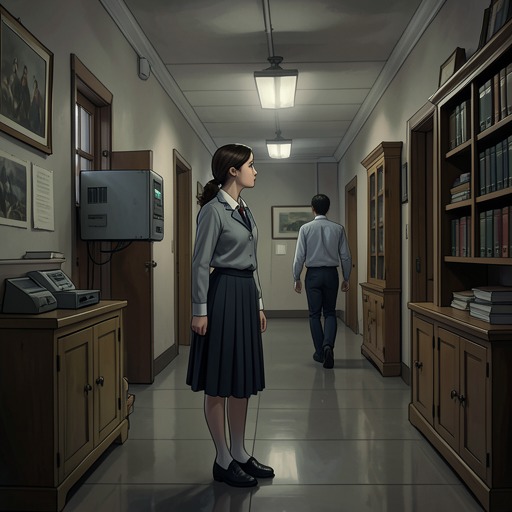
Living on their periphery, content with their crumbs
The Lying Life of Adults“Living on their periphery, content with their crumbs” is Giovanna Trada’s stark name for a future organized around someone else’s life. At four in the morning, after an ambulance siren wakes her, she decides that she will stay near Roberto discreetly, make herself loved, and accept the scraps of attention available at the edge of his relationship with Giuliana. The phrase turns infatuation into a geography: Giovanna imagines not a shared center, but a life lived around its margins.
The Plan at Dawn
Giovanna’s resolution follows a night in Roberto’s house. Alone with the thought that she will be unhappy for the rest of her life, she painstakingly arranges that unhappiness into a plan. She will learn what matters to Roberto, seek work near his, and aim to teach at a university—perhaps in Milan if Giuliana wins, perhaps in Naples if her aunt wins. These possibilities are made subordinate to one purpose: preserving the couple’s life together and helping them raise their children.
The plan is not to claim Roberto or break up his relationship with Giuliana. Giovanna instead imagines making herself useful to the couple, even mending whatever holes appear in their relationship. The phrase’s image of crumbs gives this accommodation its painful measure: she expects little, and treats proximity to Roberto as something she can live on.
A Geography of Margins
The expression resonates with the book’s earlier account of family and city. Giovanna’s father lives as though he has no blood relatives; his kin occupy a part of Naples that, to her, seems almost like another city. She grows up in the higher districts, where familiar streets lead toward Villa Floridiana, while journeys down into the city become a passage into less familiar places. The separation is not merely a matter of distance. Her father’s relatives are associated with strained visits and her parents’ weariness, leaving Giovanna to imagine their world as remote and difficult to reach.
When her father finally takes her to the neighborhood where he grew up, the journey leads through bleak apartment blocks, warehouses, sheds, garbage, and rain-filled puddles. He points out the building where he lived and where Aunt Vittoria still lives, and tells Giovanna that his family was poor. The scene gives physical form to the social boundaries that have kept her from knowing her paternal kin: descending through Naples means entering a history her parents have largely held at a distance.
Learning to Look, Finding Belonging
Vittoria takes Giovanna to meet her paternal relatives, calling the journey an encounter with her blood. Across Cavone, Campi Flegrei, and Pozzuoli, Giovanna discovers that she barely remembers these family members, perhaps never having learned their names. Vittoria rebukes her father for depriving her of their warmth, and urges Giovanna to look carefully rather than pass over what might disturb her.
The relatives welcome Giovanna readily. Their homes are small and plainly furnished; they speak in dialect mixed with Italian, and Giovanna tries to meet them in that language. They do not ask after her father, yet make clear that their hostility toward him does not extend to her. They call her Giannina, a name her parents never used, and Giovanna feels that it releases a more relaxed and affectionate version of herself. In these visits, the margins of her family history become a place of unexpected welcome. The contrast helps clarify the later force of her chosen phrase: she knows what it is to be received fully, even as she prepares to accept only leftovers in another relationship.
The Phrase’s Bitter Irony
At dawn, Giovanna’s imagined future is precise in its arrangements but narrow in its terms. Her ambitions—work, study, and a place in a university—are routed through the needs of Roberto and Giuliana; even the choice between Milan and Naples depends on Giuliana’s outcome and her aunt’s. The plan gives Giovanna a role, but only at the edge of a couple’s life, in service to its continuity and children.
The phrase therefore does more than express unrequited longing. It shows Giovanna converting emotional deprivation into a program for living: she will not ask for the center, but will try to secure a lasting presence at the perimeter. Its domestic image of crumbs makes the bargain visible, while the surrounding geography of descent and estrangement gives that imagined position a wider echo. Unlike the warmth she finds among her father’s relatives, the future she plans beside Roberto and Giuliana depends on accepting less than a place of her own.